
How to identify venomous snakes in the United States
Venomous snakes in the US belong to four groups: rattlesnakes, copperheads, cottonmouths and coral snakes. Rattlesnakes, copperheads and cottonmouths are pit vipers, with a heat-sensing pit between the eye and nostril, vertical pupils and usually a broad triangular head. Coral snakes are slender with red, yellow and black bands where red touches yellow. No single feature is foolproof, so if you are not sure, treat the snake as venomous, keep your distance and identify it from a photo.
Last checked:
Venomous snakes of the United States
Illustrated diagrams from the SlitherID field guide, with the features that tell each species apart.
-
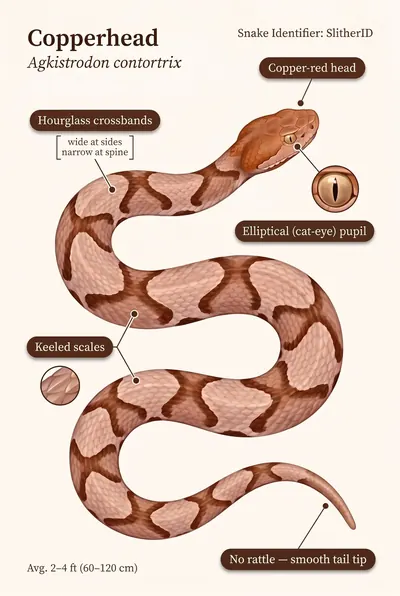 CopperheadAgkistrodon contortrixCopper head, hourglass bands. The most common venomous bite in the eastern US.
-
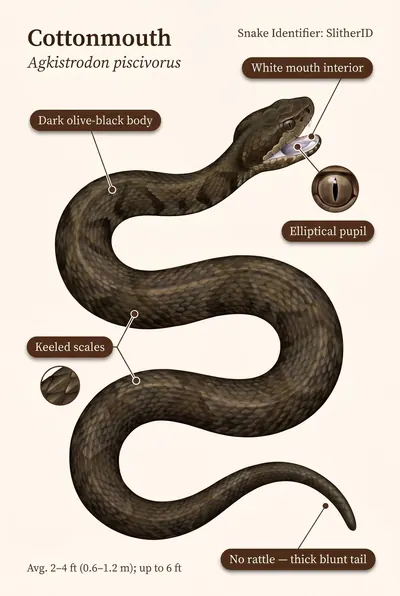 Cottonmouth (water moccasin)Agkistrodon piscivorusHeavy dark water snake that gapes to show a white mouth. Southeastern US.
-
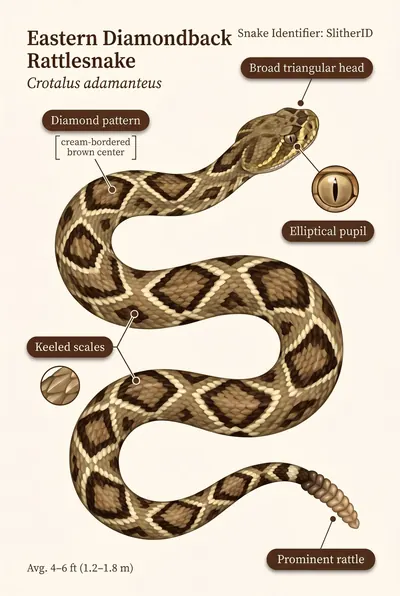 Eastern Diamondback RattlesnakeCrotalus adamanteusThe largest venomous snake in North America. Southeastern coastal plain.
-
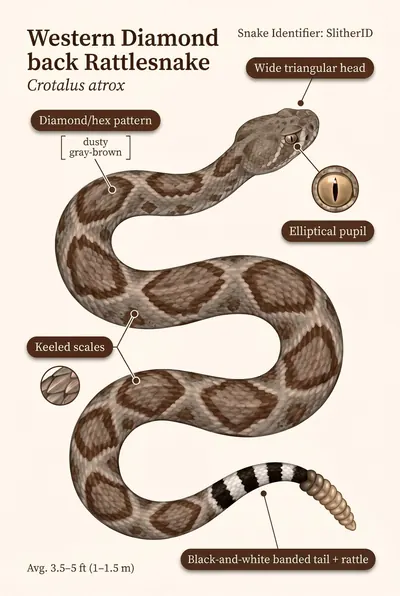 Western Diamondback RattlesnakeCrotalus atroxDusty diamonds and a black-and-white "coon tail". The Southwest's most common big rattlesnake.
-
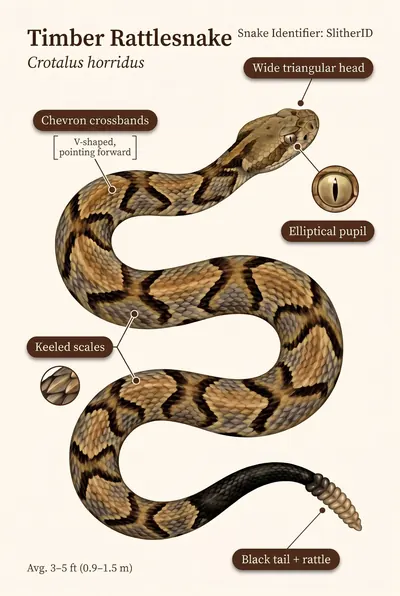 Timber RattlesnakeCrotalus horridusChevron bands and a black tail. Eastern forests from New England to Texas.
-
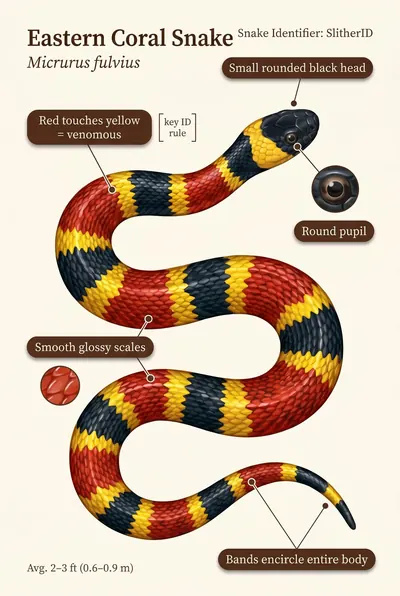 Eastern Coral SnakeMicrurus fulviusRed touches yellow. Southeastern US, smooth glossy bands and a black snout.
-
 Texas Coral SnakeMicrurus tenerRed and yellow bands touch, solid black head. Texas and nearby Louisiana.
-
 Sonoran Coral SnakeMicruroides euryxanthusSmall Arizona coral snake with red, black and white bands.
-
 Pygmy RattlesnakeSistrurus miliariusSmall, spotted rattlesnake with a tiny rattle that buzzes like an insect.
-
 Eastern MassasaugaSistrurus catenatusSmall Great Lakes rattlesnake of wetlands. Federally threatened.
-
 Prairie RattlesnakeCrotalus viridisThe rattlesnake of the Great Plains, with oval blotches and a pale eye stripe.
-
 Great Basin RattlesnakeCrotalus oreganusPale, blotched rattlesnake of the Great Basin deserts.
-
 Mojave RattlesnakeCrotalus scutulatusGreenish desert rattlesnake with wide white tail bands and a strong venom.
-
 SidewinderCrotalus cerastesSmall sand-colored desert rattlesnake with horn-like scales over the eyes.
-
 Speckled RattlesnakeCrotalus mitchelliiRock-colored desert rattlesnake covered in fine speckles.
-
 Red Diamond RattlesnakeCrotalus ruberBrick-red diamonds and a coon tail. Southern California only.
-
 Black-tailed RattlesnakeCrotalus molossusGreenish-yellow rattlesnake with a solid black tail. Southwest mountains.
-
 Tiger RattlesnakeCrotalus tigrisSmall-headed Arizona rattlesnake with tiger-like bands and a large rattle.
-
 Ridge-nosed RattlesnakeCrotalus willardiSmall mountain rattlesnake with an upturned snout and white face lines.
The four groups of venomous snakes in the US
| Group | Key features | Where |
|---|---|---|
| Rattlesnakes | Rattle or button on the tail, heat pits, vertical pupils, broad head, keeled scales | Almost every state in the lower 48; most species in the Southwest |
| Copperhead | Plain copper head, hourglass bands wide at the sides, no rattle | Eastern and central US |
| Cottonmouth (water moccasin) | Heavy dark body, white mouth lining, dark eye stripe, floats high in water | Southeastern US |
| Coral snakes | Red, yellow and black bands circling the body, red touching yellow, black snout, round pupils | Southeast, Texas and Arizona |
Features of pit vipers
- A pit (a small hole) on each side of the face between the eye and the nostril, used to sense heat.
- Vertical, cat-eye pupils. Most harmless US snakes have round pupils.
- A broad, triangular head clearly wider than the neck. Harmless snakes can flatten their heads to look similar, so do not rely on this alone.
- A rattle or button at the tail tip in rattlesnakes. Copperheads and cottonmouths have no rattle.
- Under the tail, after the vent, US pit vipers have a single row of scales, while most harmless snakes have a double row. This is easiest to check on a shed skin.
Coral snakes: red touches yellow
US coral snakes are small, slender and glossy, with bands that circle the whole body. In the United States, red bands touching yellow bands means a coral snake, and red touching black means a harmless look-alike such as a kingsnake or milk snake. The rhyme does not work outside the US.
Coral snake venom affects the nervous system, and symptoms can be delayed for hours. Anyone bitten needs emergency care even if they feel fine.
Myths that get people hurt
- Myth: "Venomous snakes always have triangle heads." Harmless snakes flatten their heads when threatened, and coral snakes have small rounded heads.
- Myth: "A rattlesnake always rattles first." Rattlesnakes may stay silent, and babies have only a silent button.
- Myth: "Water snakes are cottonmouths." Most snakes in US water are harmless water snakes.
- Myth: "Kill it to be safe." Many bites happen while trying to kill or move a snake. Leave it alone and it will usually leave.
How common are venomous snakebites?
The CDC estimates that 7,000 to 8,000 people are bitten by venomous snakes in the US each year, and about 5 of them die. Prompt medical treatment is the main reason the death rate is so low.
What to do if someone is bitten
- Move away from the snake. Do not try to catch or kill it; a photo from a safe distance is enough.
- Call 911, or Poison Control at 1-800-222-1222.
- Keep the person calm and still, and keep the bite at about heart level.
- Remove rings, watches and tight clothing near the bite before swelling starts.
- Do not cut the wound, suck out venom, apply ice or use a tourniquet.
Not sure about a snake? Take a photo from a safe distance and SlitherID will tell you if it is venomous.

Questions and answers
How many venomous snakes are there in the US?
Which state has the most venomous snakes?
Are baby venomous snakes dangerous?
Is "poisonous snake" the same as "venomous snake"?
Sources
- CDC NIOSH: Venomous snakes
- Poison Control: Rattlesnake bites, what you need to know
- America's Poison Centers: Bites and stings
Last checked: November 29, 2026