
Identification chart
Venomous snake identification chart (US)
Short answer
This chart shows the 19 venomous snakes in the SlitherID field guide, each with the features that tell it apart. Rattlesnakes have a rattle, broad heads and vertical pupils; copperheads have hourglass bands; cottonmouths are dark and heavy with a white mouth; coral snakes have red bands touching yellow. Print it for the trail, or tap a snake for its full guide.
Last checked:
-
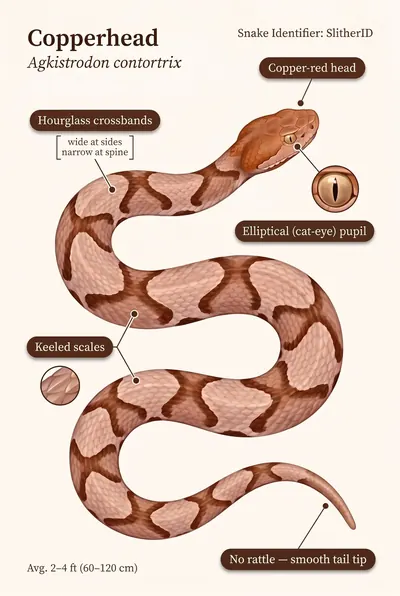 Copperhead
- Unmarked copper-red to orange head, broad and triangular
- Hourglass crossbands: wide at the sides, narrow at the spine (like a Hershey's Kiss seen from the side)
- Elliptical, cat-eye pupils and a heat-sensing pit between eye and nostril
-
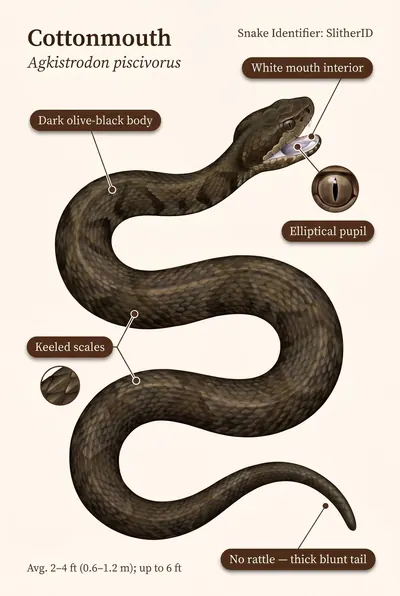 Cottonmouth (water moccasin)
- Thick, dark olive to black body; older snakes may look almost solid dark
- White, cotton-like mouth lining shown in a defensive gape
- Broad, blocky head with a dark stripe through the eye and elliptical pupils
-
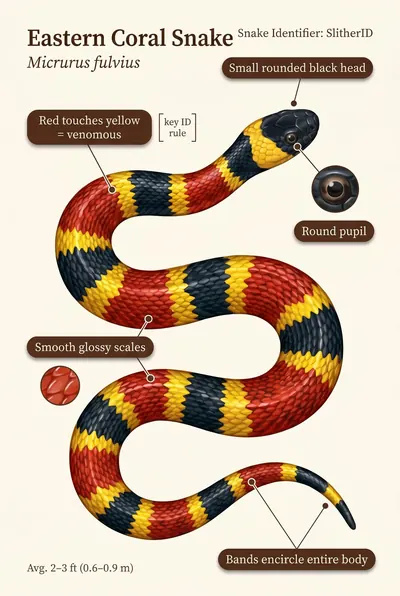 Eastern Coral Snake
- Red, yellow and black bands that go all the way around the body
- Red bands touch yellow bands ("red touches yellow" in US coral snakes)
- Small rounded head with a black snout followed by a yellow band
-
 Texas Coral Snake
- Red and yellow bands touch each other
- Bands circle the entire body, including the belly
- Solid black head and snout with a yellow band behind it
-
 Sonoran Coral Snake
- Red, black and white or cream bands circling the body
- Light bands are white or pale yellow, not bright yellow
- Small, blunt black head
-
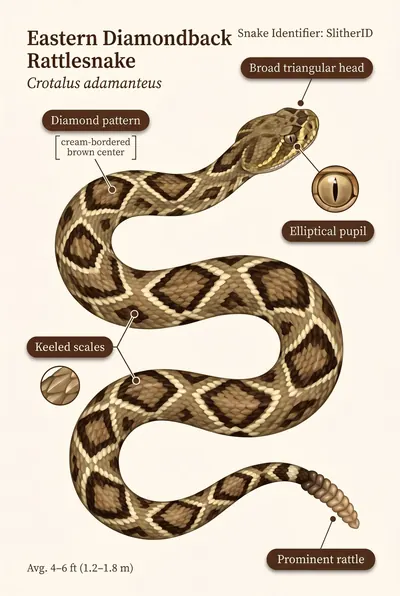 Eastern Diamondback Rattlesnake
- Dark diamonds with cream or yellow borders and brown centers along the back
- Broad triangular head with two light diagonal lines on each side of the face
- Elliptical pupils and heat-sensing pits
-
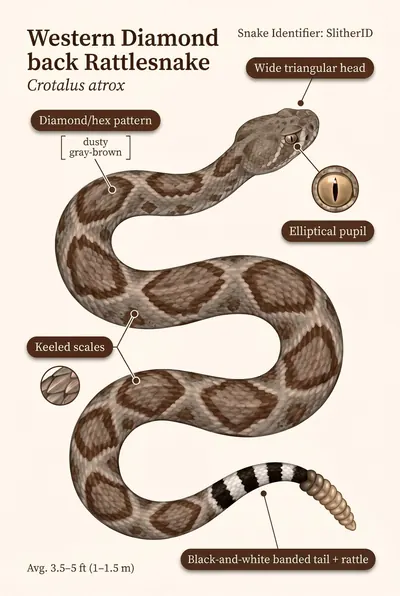 Western Diamondback Rattlesnake
- Dusty gray-brown diamond or hexagon pattern, often with fuzzy edges
- Black and white tail bands of about equal width (the "coon tail")
- Wide triangular head with two light diagonal lines on the face
-
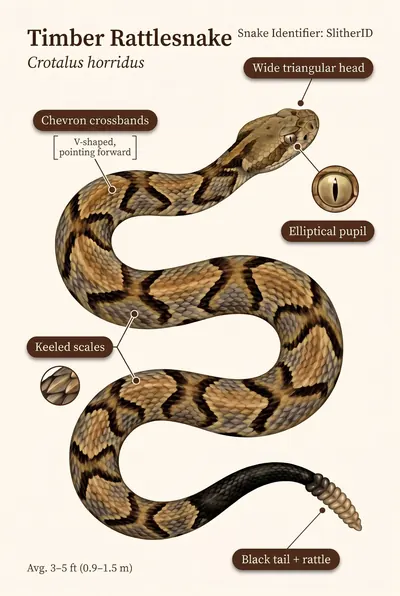 Timber Rattlesnake
- Dark chevron (V-shaped) crossbands pointing toward the head
- Solid black tail just before the rattle
- Wide triangular head, elliptical pupils and heat-sensing pits
-
 Pygmy Rattlesnake
- Rows of dark rounded spots along the back and sides
- Often a reddish or orange stripe down the middle of the back
- Large head plates and elliptical pupils, with heat-sensing pits
-
 Eastern Massasauga
- Rounded dark brown blotches on a gray to light brown body
- Nine large plate scales on top of the head (most rattlesnakes have many small scales)
- Elliptical pupils and heat-sensing pits
-
 Prairie Rattlesnake
- Oval, rounded dark blotches along the back
- Pale stripe behind the eye
- Greenish, olive, tan or gray body color
-
 Great Basin Rattlesnake
- Irregular dark blotches on a pale background
- Blotches turn into bands near the tail
- Wide triangular head with elliptical pupils and heat pits
-
 Mojave Rattlesnake
- Greenish-gray to olive color (some are brown)
- Crisp diamonds with light edges along the back
- Tail rings: white bands are wider than the black bands
-
 Sidewinder
- Horn-like raised scales above each eye
- Sandy pink, tan or cream color with faint blotches
- Elliptical pupils and heat-sensing pits
-
 Speckled Rattlesnake
- Speckled scales, each with several colors
- Color matches local rock: white, pink, gray, tan or orange
- Faint bands or blotches and a banded tail
-
 Red Diamond Rattlesnake
- Reddish, brick or pinkish-tan body color
- Diamond pattern with light edges, often faint
- Black-and-white banded tail before the rattle
-
 Black-tailed Rattlesnake
- Solid black tail before the rattle
- Irregular dark crossbands with light centers
- Greenish, yellowish or olive body color
-
 Tiger Rattlesnake
- Faint crossbands like tiger stripes along the whole body
- Very small, narrow head for its body
- A large rattle for the snake's size
-
 Ridge-nosed Rattlesnake
- Upturned, ridged tip of the snout
- White lines on the face and white-edged crossbands
- Reddish brown to gray body
Rattlesnake identification chart
| Rattlesnake | Pattern | Tail | Where in the US |
|---|---|---|---|
| Eastern diamondback | Dark diamonds with cream borders | Brownish, banded | Southeastern coastal plain |
| Western diamondback | Dusty gray-brown diamonds | Black and white bands of equal width | Texas to southeastern California |
| Timber | V-shaped chevron bands | Solid black | Eastern US |
| Prairie | Oval brown blotches, pale eye stripe | Faint bands | Great Plains |
| Great Basin | Irregular blotches on a pale body | Bands near the tip | Great Basin |
| Mojave | Crisp diamonds, often greenish | White bands wider than black | Desert Southwest |
| Sidewinder | Faint blotches on sandy color, horns over eyes | Small rattle | Desert Southwest |
| Speckled | Speckled, rock-matching colors | Banded | Desert Southwest |
| Red diamond | Brick-red diamonds | Black and white bands | Southwestern California |
| Black-tailed | Irregular bands on greenish yellow | Solid black | Arizona, New Mexico, Texas |
| Tiger | Faint tiger-stripe bands, tiny head | Large rattle for its size | South-central Arizona |
| Ridge-nosed | White-edged bands, upturned snout | Small rattle | Southeastern Arizona, southwestern New Mexico |
| Pygmy | Round dark spots, reddish stripe | Tiny rattle that buzzes | Southeastern US |
| Eastern massasauga | Rounded brown blotches, large head plates | Small rattle | Great Lakes region |
Venomous or harmless? Quick comparison
| Feature | US pit vipers | US coral snakes | Most harmless US snakes |
|---|---|---|---|
| Pupils | Vertical | Round | Round |
| Heat pit by the nostril | Yes | No | No |
| Head | Broad, triangular | Small, rounded, black snout | Narrow (some flatten when scared) |
| Scales under the tail | Single row | Double row | Double row |
| Rattle | Rattlesnakes only | No | No (some shake their tail) |

Snap a photo instead of flipping through a chart. SlitherID identifies the species and venom status in seconds.

Questions and answers
Can I print this chart?
Yes. Use the print button or your browser's print command; the page is laid out to print cleanly.
Does the chart include every venomous snake in the US?
It covers the 19 species in the SlitherID field guide, which includes all four groups and the rattlesnakes most people meet. A few rare rattlesnakes, such as the rock rattlesnake and twin-spotted rattlesnake, are not shown.
Sources
- CDC NIOSH: Venomous snakes
- US Fish and Wildlife Service: Eastern massasauga listed as threatened (2016)
Last checked: November 29, 2026